


The national debt recently passed $40 trillion. Most of us can’t even wrap our minds around a number that big. I know I certainly can’t.
Beyond its size, the debt’s rate of growth concerns many economists. It is roughly double its September 2017 level of $20 trillion and roughly four times its level in 2008.
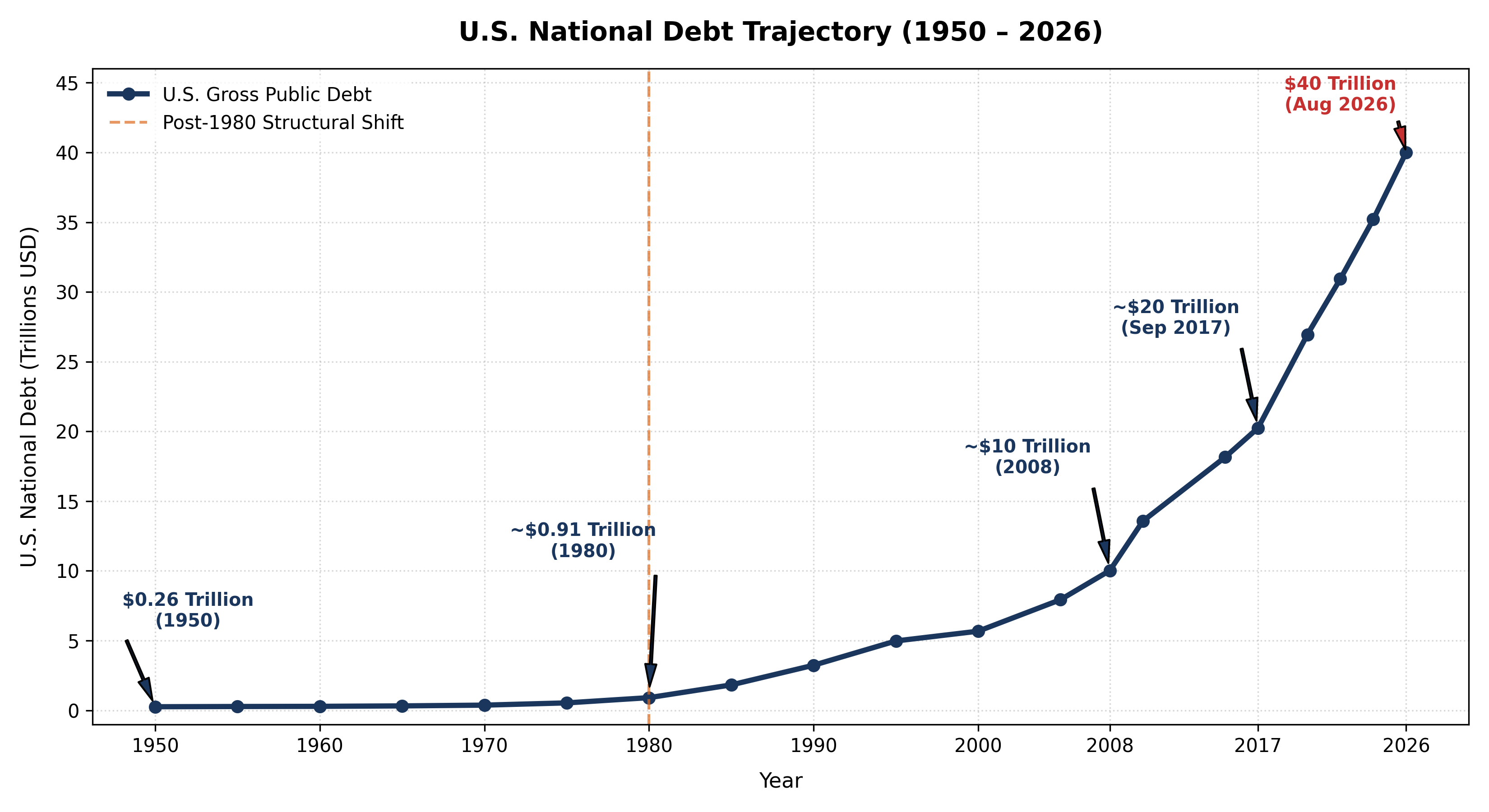
Crossing a milestone like that makes for splashy headlines, but the political shouting matches around the national debt are nothing new. For decades, political rhetoric around national borrowing has relied on similar scripts: Washington should budget like a family; we’re leaving the bill to our grandchildren; the other party caused the problem. Our own priorities are the exception: debt becomes more alarming when the other party is governing—and more tolerable otherwise.
“Tax the rich” is another recurring script, containing both a serious policy argument and a tempting political shortcut. The serious argument is that those with the greatest ability to pay should contribute more, and that doing so can materially reduce borrowing. The shortcut is implying that this removes every other hard choice.
These narratives tend to frame borrowing as a question of morality, blame, or painless solutions, rather than budget arithmetic realities. The wording changes, but these frames recur across decades.
Reporting on the latest debt milestone reflects agreement that the trajectory is troubling and crosses party lines, but little acknowledgment of the politically painful choices needed to change it.
If you’ve listened to Outrage Overload before, this pattern is painfully familiar. Complex, long-term structural problems get reduced to easy villains and quick slogans. Both sides offer silver-bullet solutions that sound great in a thirty-second soundbite or TikTok reel, but leave us with unrealistic expectations—and little understanding of how federal borrowing and budgeting actually work.
As average folks trying to make sense of the noise, many of us are left feeling caught in the middle. The debt keeps climbing no matter who is in office, yet the actual mechanics driving our national budget remain hidden beneath political posturing.
For me, the standard talking points simply weren’t adding up. I had questions that neither political binary was answering:
Why does the debt curve look like a staircase that only goes up? Historically, debt spiked during major crises—like World War II—and fell during times of peace and economic growth. But starting around 1980, that pattern broke. Why has debt risen continuously across both Republican and Democratic administrations, through booms and busts alike?
Why does our safety net feel so fragile if we are spending so much? Americans are constantly told that “entitlements” are eating the budget, yet our social expenditures look modest compared to other developed nations. Why are systems like healthcare and Social Security under permanent strain?
How do other nations avoid this trap? When people point to Nordic countries, they often frame them as socialist paradises or tax-and-spend warnings. What are the actual mechanical differences in how those countries fund public goods compared to the U.S.?
What are Treasury operations like “Operation Twist” actually doing? When news broke that the U.S. Treasury was expanding multi-billion-dollar long-term bond buybacks and funding them with short-term bills, financial analysts called it a fiscal “Operation Twist.” Was this a brilliant fix to lower borrowing costs, or just moving numbers around on a balance sheet to paper over structural deficits? And should we be concerned?
I didn’t want another partisan shouting match or a simplified cable-news segment. I needed someone who could look past the political noise, explain the underlying financial machinery, and help us understand how our government’s budget process actually functions.
That search led me to Eugene Steuerle.
Finding the Adult in the Room
Gene Steuerle isn’t a political pundit; he is an economist who has spent decades inside the mechanics of federal tax and budget policy. As a former top Treasury official who coordinated the historic Tax Reform Act of 1986, a co-founder of the Urban-Brookings Tax Policy Center, and the author of Abandoned: How Republicans and Democrats Deserted the Working Class, the Young, and the American Dream, Gene has watched our fiscal policy evolve from the inside for over forty years.
What makes Gene’s perspective so refreshing is that he doesn’t blame one political party or subscribe to simple ideological answers. Instead, he points to a structural shift in how Washington operates—a concept he calls the loss of “fiscal democracy.”
In our conversation, Gene helps us understand that modern lawmakers aren’t necessarily driving the growth through new spending. Instead, past Congresses have placed the budget on autopilot. Through permanently expanding entitlement formulas and pre-committed tax expenditures, future revenues are locked up before a single vote is cast.
When a new crisis or need arises, elected officials no longer have the budget flexibility to address it out of existing revenues—so they borrow. The result is a structural design trap that binds lawmakers on both sides of the aisle, leaving younger generations and working families to bear the long-term risk.
Step Behind the Headlines
We recorded this conversation to give everyday readers and listeners a clear, diagnostic view of the U.S. financial system—without the panic, partisan finger-pointing, or confusing jargon.
If you’ve ever felt frustrated by the noise surrounding the national debt, curious about how Nordic systems actually fund their public goods, or wondered what financial maneuvers like Treasury bond buybacks mean for your future, this episode is for you.
Available now on Spotify, Apple Podcasts, Substack, or wherever you listen to your podcasts.
Help Us Celebrate Episode 100: How Has the Show Shifted Your Perspective?
As we approach Episode 100, we’re taking a moment to reflect on the journey since 2022. Our core mission on Outrage Overload has always been to help you step off the outrage treadmill, reclaim your peace of mind, and understand the hidden machinery driving political polarization.
For our upcoming Episode 100 milestone special, we want to feature your voices.
We’d love to hear how the show has impacted your daily life, your relationship with news, or how you view the political landscape. Leave us a short 30-to-60-second voice message on our SpeakPipe (or drop a comment below).
Need some inspiration? Pick one of these prompts and tell us your story:
1. The Mindset & Well-Being Shift
Reclaiming Calm: Do you feel more in control of your news consumption habits, or are you still struggling to set healthy boundaries around outrage-driven media?
Lowering stress: Do you feel less anxious or overwhelmed by the daily stream of political headlines compared to a year or two ago?
2. Looking in the Mirror & Beyond
In-group accountability: Have you become more critical or mindful of outrage tactics used by political figures or media outlets on your own side?
Humanizing the other side: When you hear an opposing view that used to make you furious, are you now more curious about the underlying fears or incentives driving it?
Tribal Reflexes: What is one belief or political knee-jerk reaction you’ve re-examined or softened after learning about the cognitive science behind polarization?
3. Real-World Impact
Navigating tough conversations: Have you used a concept or research finding from the podcast to de-escalate a tense conversation with a friend, family member, or coworker?
Smarter media consumption: How has understanding algorithms, cognitive bias, and outrage incentives changed what you read, watch, or share?
Human Connection: Do you feel more confident that the 'Exhausted Majority' actually exists and that genuine bridge-building is still possible?
🗣️ Click Here to Record Your Voice Message on SpeakPipe
(Tip: Keep it around 30 to 60 seconds, state your first name and general location if you’re comfortable, and hit send! You can also reply directly to this post if you prefer to write your thoughts.)