


This week, Lisa and David talk about House Republicans pass $1.1 trillion in funding for the military including SAVE Act and Iran funding; Trump’s deranged Correspondents’ Dinner appearance and the media’s silent acceptance; Cecilia Vega of 60 Minutes says Bari Weiss pressured her to include “misinformation” and “political bias” in news segments; Cybertruck reported as the biggest flop in automotive history; measles cases reach 35-year high amid a decadeslong slide in childhood vaccination rates; Trump launches fresh round of tariffs, creating a new potential drag on global growth; DOJ withdraws subpoenas to NY Times reporters; California ballots rejected possibly due to new U.S. Postal Service changes affecting postmarks; Trump orders Smithsonian sigage to combat “extreme political activism, rooted in Marxism, to divide, dispirit, and discourage Americans"; ‘Jimothy’; plan to reintroduce grizzly bears in California; OpenAI says its AI “went rouge” and hacked into another AI company; and more.
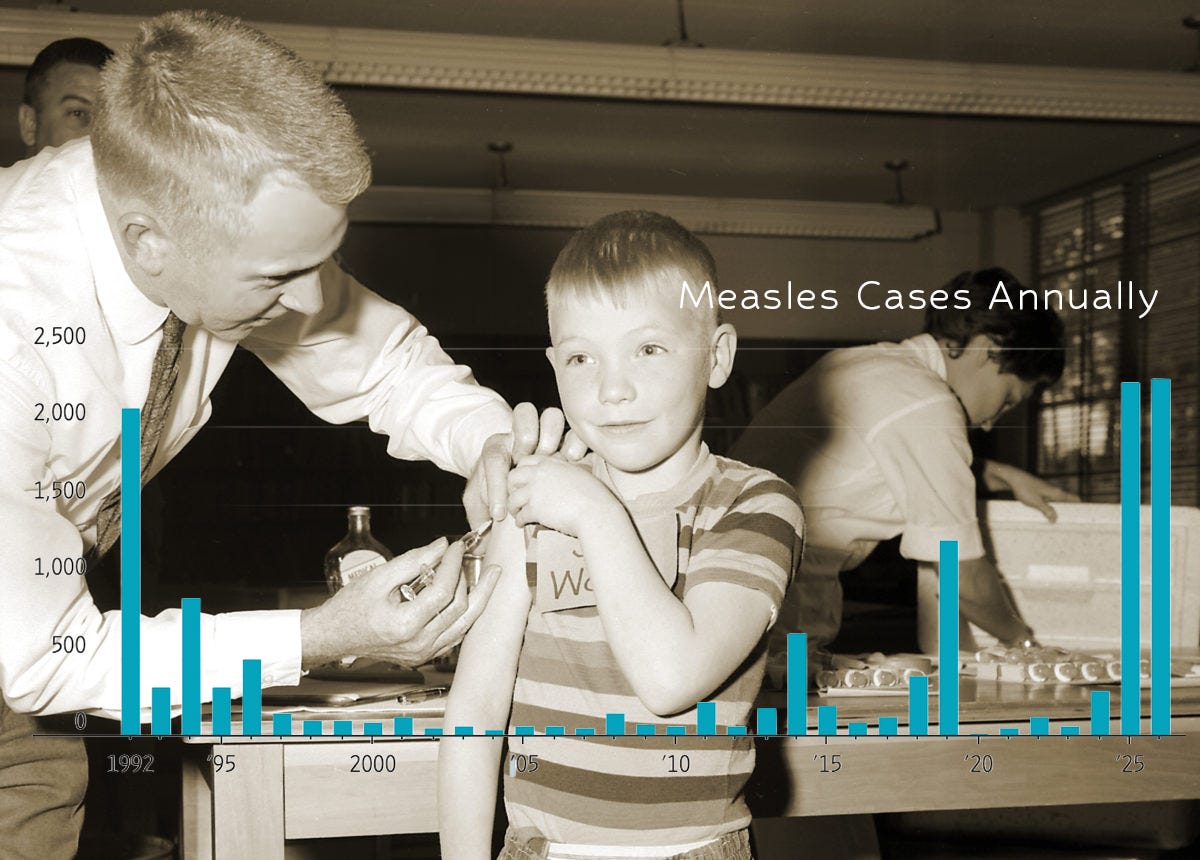
U.S. Measles Cases So Far This Year Hit a Three-Decade High
“We have joined the rank of countries where vaccination is not reaching the levels needed to protect all of our children against some of the most contagious diseases.
Measles is the canary in the coal mine. What it’s saying is that our communities are vulnerable, not just from measles, but from whooping cough, meningitis, chicken pox and other diseases that are readily controllable with vaccines. We’re on a crash course.”
- Dr. Richard Besser, a pediatrician and president of the Robert Wood Johnson Foundation
Added Context for Military Spending Bill and the SAVE Act
The U.S. House of Representatives narrowly passed a historic $1.15 trillion fiscal year 2027 National Defense Authorization Act (NDAA), featuring a 5% to 7% military pay raise, a provision to rename the Department of Defense to the Department of War, and funding considerations connected to ongoing operations in Iran. The legislation cleared the chamber on a tight 216-212 vote largely along party lines.
Core Provisions & Debates
Department of War: Includes an adopted measure to officially redesignate the Department of Defense.
Iran Conflict & Israel: Advances policy and funding support addressing the war with Iran alongside provisions to expand U.S.-Israeli military cooperation.
Political Divisions: Opposing Democrats cited objections to mounting war costs and policy riders, while supporting Republicans emphasized the necessity of funding operations, equipment, and troop benefits.
The bill now moves to the Senate.
The House passed a rule to attach the full SAVE Act to the National Defense Authorization Act (NDAA) which is seen as messaging.
The actual plan to clear the Senate relies on a newly advanced $95 billion budget reconciliation framework, which reshapes the SAVE Act into a budgetary mechanism.
A bill passed through reconciliation must survive intense procedural and political hurdles before becoming law. Even though structured as financial grants, the Senate Parliamentarian already ruled that policy provisions tied to the SAVE Act violate the “Byrd Rule”—a strict Senate guideline requiring all reconciliation elements to be primarily budgetary rather than driven by policy changes.
Experts are generally saying military and agricultural funding tracks are legally and procedurally cleared to survive reconciliation, but the SAVE Act funding faces a nearly impossible uphill battle to survive the Senate’s procedural gauntlet.
Added Context for the War Powers Act
The War Powers Resolution technically applies to military actions involving Iran, but President Trump has bypassed its restrictions by exploiting legislative fractures and shifting the definition of ongoing operations. Because Congress remains deeply divided along partisan lines, it has failed to pass binding, veto-proof legislation to halt hostilities. Instead, the House has largely relied on non-binding or symbolic resolutions, while the Senate fell short of the votes needed to enforce a mandatory withdrawal of American forces.
To sidestep the statute’s strict 60-day deadline for unauthorized conflicts, the administration frames intermittent flare-ups, localized airstrikes, and sudden ceasefires as separate, independent incidents rather than one continuous, undeclared war. Furthermore, the White House asserts broad executive authority under Article II of the Constitution, arguing that the President possesses the inherent power as Commander-in-Chief to launch defensive strikes against imminent threats to American personnel without needing explicit congressional approval.
Added Context for Trump’s Unprecedented Spectacle at the WHCD
The speech should be described as unhinged in tone, unprecedented in setting, and dangerous in what it normalizes. A sitting president using a rescheduled journalists’ dinner to recycle attack lines, insult specific reporters, and blur the line between official remarks and rally-style grievance politics is not normal governance; it is a deliberate stress test of democratic norms.
What makes it especially alarming is that the room’s response can itself become part of the story. Reports describe nervous laughter, moments of silence, and a ballroom that largely absorbed the performance rather than forcefully rejecting it, which is exactly how behavior that once felt shocking starts to harden into routine.
The danger is not just the content of the speech; it is the permission structure around it. When journalists, political officials, and institutions respond with resignation, the message becomes that personal abuse, falsehoods, and authoritarian-style performance are simply the new baseline.
This wasn’t just a bad speech. It was a normalized display of cruelty, contempt, and lawless rhetoric, performed in front of the press corps that is supposed to hold power accountable — and the fact that the room mostly sat there is part of the problem.
Links:
Yergz Radio (yergzradio.com)
Dare Talk Radio (daretalkradio.com)
This Week in Outrage Substack (outrageoverload.net/twio)
5 standout moments from Trump’s appearance at makeup WHCA dinner (The Hill)
Trump jokes mostly fall flat at WHCA dinner as he attacks journalists and political foes (CNN)
Are oil companies profiting from the Iran war? Experts explain (ABC News)
It’s Looking Like the Cybertruck Is the Biggest Flop in Automotive History (Futurism)
The worst year for measles in a generation (Vox)
Why Trump’s new tariff blitz is very different this time around (CNBC)
DOJ withdraws subpoenas to NY Times reporters in Trump plane probe (CNBC)
Trump orders Smithsonian to post warnings about ‘inaccurate’ US history (BBC)
A Teen Reporter Searched for His Community in the Epstein Files. Adults Freaked Out (Wired)
OpenAI blamed a hacking event on its AI models going rogue. Here’s what to know (PBS)


