

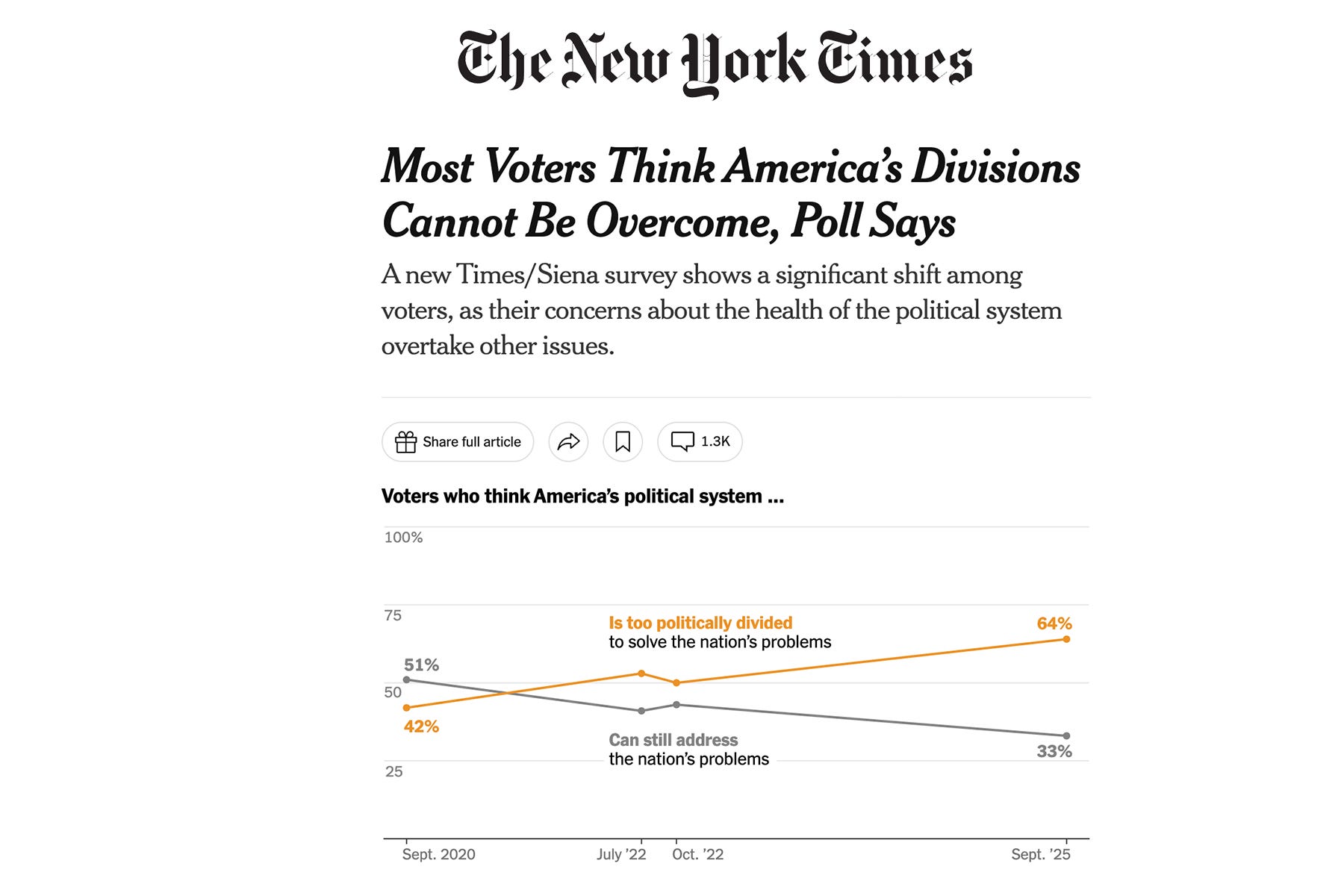
The recent New York Times/Siena poll offered some fascinating insights into how Americans see the state of our democracy—but the headline missed the mark. The Times led with: “Most Voters Think America’s Divisions Cannot Be Overcome.” That sounds final, absolute, hopeless. But it isn’t what the poll actually asked.
The question was: “Do you think America’s political system can still address the nation’s problems, or is it too politically divided to solve its problems?” That’s very different from saying our divisions themselves are permanent. The poll reflects skepticism about the system’s functionality, not fatalism about our ability to live together.
In fact, polarization itself ranked as the second most important issue facing the country—behind only the economy. The article notes that this is a big change:
Before the 2024 election, polls showed that people were more likely to identify issues such as inflation, abortion and immigration as most important to their vote.
Polarization barely registered (<1%).
But here’s where it gets interesting: despite the noise, the vast majority of Americans do not see people in the other party as “the enemy.” Among Democrats and leaners, 84% said Republicans are “fellow Americans” they disagree with; among Republicans and leaners, 82% said the same about Democrats.
Voters on both sides assume the other side is far more hostile than their own. But the numbers tell a different story. Among Democrats and Democratic-leaning independents, only 10% see Republicans as “the enemy.” Among Republicans and Republican-leaning independents, the number is still just 14%.
In other words, the vast majority of Americans—on both sides—do not view the other party as an existential threat. The problem isn’t that we see each other as enemies, it’s that we believe the other side sees us that way. That misperception is itself fuel for polarization—and it’s fed daily by outrage-driven media.
The poll also reflects some real anxiety: one-third of Americans say our problems are so severe that the nation is in danger of failing. That’s serious. But it’s not the same as declaring we can never bridge divides.
The danger isn’t that we’ve given up on one another. It’s that we’ve lost faith in the system’s capacity to function. And that’s a very different—and more solvable—problem than the headline suggests.
Opinions are one thing but personal attacks, whether directed at me or someone else, cross a line.
> That misperception is itself fuel for polarization—and it’s fed daily by outrage-driven media.
the president said that Democrats are Satan personified and declared them 'dead' last night
your myopic focus on 'the media' as a sort of division falls short of the actual reality:
a violent fascist movement in the United States induced a schism into two narrative bubbles
AT SOME POINT YOU WILL HAVE TO ACCEPT THIS AS FACT.