


There has been a significant amount of buzz in the bridge-building movement recently regarding a groundbreaking new report from More in Common. Titled “Beyond MAGA: A Profile of the Trump Coalition,” this research is a truly terrific piece of work. Based on a massive survey of over 18,000 Americans—including 11,000 Trump voters—it offers perhaps the most comprehensive and humanized fieldwork ever conducted on this influential segment of the electorate.
By moving past “flattened” national narratives that focus solely on demography, the report reveals the complex starting points and values that drive different factions within the Republican coalition, from the “MAGA Hardliners” to the “Reluctant Right”. It is precisely the kind of data we need to move beyond stereotypes and toward actual understanding.
However, as I’ve sat with this data, I keep returning to a fundamental, challenging problem it highlights—one that hits close to home for many of us in the work of reconciliation: the Unity Paradox.
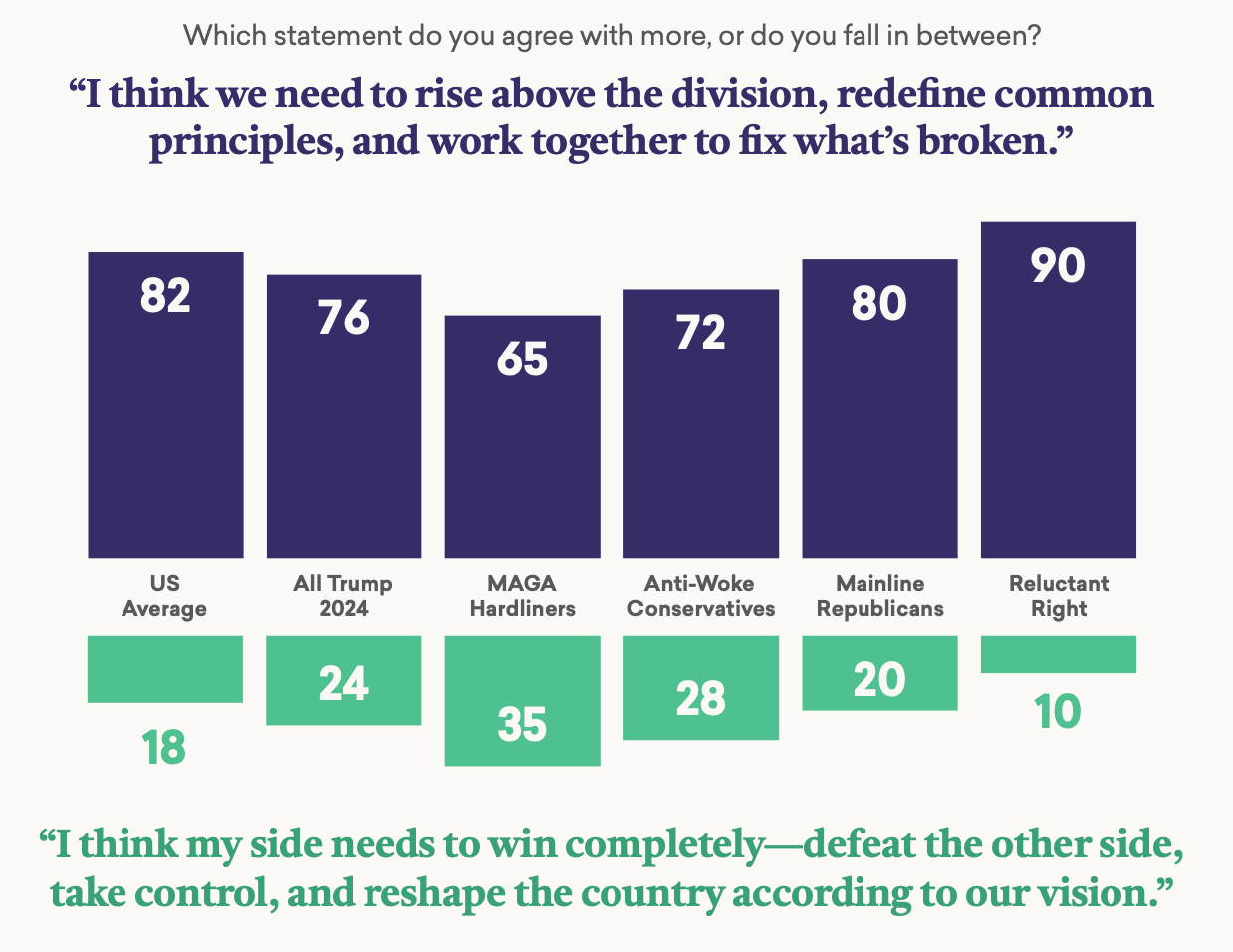
On the surface, the More in Common data is incredibly hopeful. When asked if they would rather “win completely” by defeating the other side or “rise above our divisions” to redefine common principles, an overwhelming 76% of Trump voters choose unity. Even among the most ardent MAGA Hardliners, a two-thirds majority says they want to move past the conflict. We are, it seems, a nation united by our exhaustion with division.
But there is a catch. In my own less scientific research interviewing dozens of people over recent years, I’ve found that when you push past the desire for “compromise,” a deeper reality emerges. We say we don’t want division, but when you really dig in, the way most people prefer to end that division is by having the other side finally “come to their senses” and come around to our way of thinking. We don’t see this as “domination” of the other side. It’s just common sense.
This creates a fundamental, perhaps even insurmountable, challenge for national reconciliation. We are desperate to lower the temperature of division, yet we are simultaneously unwilling to concede space to ideas we find fundamentally unacceptable. As even one of the researches in this study put it to me: “I don’t like the division, but I don’t like to, speaking for myself, grant legitimacy to claims that elections were stolen when there’s not good evidence that they were.”
This is the tension at the heart of the American electorate in 2026. We are a people who feel the call for unity, but we are also a people who refuse to abide or validate perspectives that we believe undermine the very foundation of our shared reality. We want a bridge, but we refuse to let the other side build their half with materials we find factually or morally toxic.
In this article, I want to pick out a few key findings from this research—things that might be genuinely surprising to partisans on both sides—to see if we can understand the contours of this coalition better. But ultimately, we must circle back to the core challenge: how do we find a path forward when our very definition of “unity” is problematic.
There’s a lot more in this important research than the few points I highlight below. You definitely want to check out the full report.
The “Warmth” Gap Toward Immigrants
Contrary to the partisan narrative that Trump voters are uniformly anti-immigrant, they actually express the same level of “warmth” toward legal immigrants (score of 70) as the average American. The “chasm” only opens regarding undocumented immigrants, where warmth drops to 20 (vs. US Average of 39). This frustration is shared across racial lines, with Hispanic and Black Trump voters often feeling the most “disrespect” from lawlessness.
This is a prime example of an “unacceptable idea.” To many partisans on the right, there is a settled belief that the American left no longer distinguishes between legal and undocumented status—that any mention of “legality” is viewed by the other side as a moralized dog whistle.
However, the data suggests a more hopeful, if complex, reality. While a small, vocal activist slice of the left may indeed view the distinction through that lens, they represent a fraction of the Democratic coalition. For the vast majority of Americans, the “warmth” toward legal immigrants remains high and remarkably consistent across the board.
The “unacceptable idea” here isn’t necessarily the policy of immigration itself, but the perceived extremity of the other side.
The Right looks at the left and sees a movement that has abandoned the rule of law entirely.
The Left looks at the right and sees a movement motivated by animus toward all newcomers.
This leads us to a crucial opportunity to lower the temperature. Much of what we find ‘unacceptable’ about the other side is based on the loudest voices in the room, not the person living next door. If we can see that the ‘other side’ isn’t the caricature we’ve built in our heads, the path to unity shifts. It moves from ‘how do I defeat this existential threat?’ to ‘how do I navigate a world where we both value many of the same things but prioritize them differently?’
Yet, even with that clarity, the challenge remains: can we handle a version of unity that doesn’t end with the other side admitting they were wrong?
The Existence of the “Reluctant Right”
One-fifth of the Trump coalition (the “Reluctant Right”) is highly critical of him, giving him grades of Ds and Fs on many issues.
Unlike the “MAGA Hardliners,” 8 in 10 members of this group believe both the left and right love America. They don’t see the other side as an “existential threat” and support Trump primarily for pragmatic reasons like the economy or immigration.
This group is the living embodiment of the challenge. They feel the division most acutely and reject the “existential threat” narrative, yet they still voted for a candidate that the other side finds fundamentally unacceptable. They are the ones who likely say, “I don’t like the division, but I find the alternative (e.g., economic policy or border management) even more unacceptable.”
The “Woke” Disconnect
While “wokeness” is a central battleground for MAGA Hardliners and Anti-Woke Conservatives, many “Mainline Republicans” and “Reluctant Right” voters don’t even know what the term means.
In focus groups, these voters couldn’t connect local cultural controversies to a broader “woke” umbrella. Furthermore, only 22% of Trump voters actually perceive “reverse racism” as a major issue.
This suggests that much of the division is driven by “flattened” national narratives that don’t reflect the daily lives of many voters. When we “push” people, they aren’t looking for a compromise on abstract cultural theories; they are looking for a return to what they consider “common sense”—which is just their own way of thinking.
Respect as the “Redeemer”
A massive gap exists in the perception of respect: 84% of Trump voters believe Donald Trump respects them, while only 21% feel the same about Democratic politicians.
This “powerful social function” is why voters ignore his “blasphemous” or “destructive” traits; they see him as a “builder” fixing a system that looks down on them.
This gets to the heart of why “coming to their senses” is the only path people see. If you feel fundamentally disrespected by the other side, any compromise feels like a surrender to someone who hates you. Therefore, the only way to end division without losing your dignity is for the “other side” to finally see your value and come around to your perspective.
The "Unacceptable Idea" and the Wall of Belief
If the More in Common data is the map, then our personal interactions are the terrain. The report shows us a clear, road toward unity: 76% of Trump voters—and a similar supermajority of the country at large—want to “rise above our divisions” rather than “win completely”. It is a beautiful sentiment. But when we start walking that road, we quickly find ourselves tripping over “unacceptable ideas.”
We want the temperature to be lower, but we don’t want to lower it by validating things we find fundamentally untrue or morally repugnant.
For many on the left, the idea that a democratic election was fraudulent is a non-starter; to entertain it feels like a compromise with a lie. Yet, for a MAGA Hardliner, the “unacceptable idea” might be the validity of institutional DEI and gender mandates; to concede these points feels like participating in a forced linguistic and cultural ‘re-education’ that betrays objective truth.
The paradox is that we don’t see our desire for unity as a demand for conquest. We tell ourselves we hate the division and have no desire to dominate. We see our own position not as a partisan ‘red line,’ but as the neutral baseline of a sane society. We aren’t asking for their surrender—or so we think—we’re just waiting for them to see reason. We know they will come around because their core beliefs feel like a rejection of reality itself. We see our terms for peace as self-evident, yet to those across the aisle, it is experienced as an extinction of their worldview.
Beyond the Illusion of the “Neutral” Baseline
If we are to move beyond the current deadlock, we must first confront the uncomfortable truth revealed by both the More in Common data and our own internal monologues: our path to unity is blocked by our own definitions of “normal.”
The More in Common report is a vital tool because it shatters the caricatures we use to justify our distance. It shows us a “Reluctant Right” that is critical of its own leaders, a Hispanic and Black constituency that shares many of the same frustrations as the “Mainline,” and a broader coalition that—despite the headlines—still believes in the inherent value of their neighbors. It suggests that the “existential threat” we perceive is often a product of the loudest, most extreme voices rather than the person sitting across the table.
Yet, even when we lower the perception gap, we are left with the core of the paradox. We are weary of the conflict and sincerely believe we have no interest in imposing our will. We see our own position not as a partisan “red line,” but as the neutral baseline of a sane society. We aren’t asking for their surrender—or so we think—we’re just waiting for them to see reason. We expect them to come around because their core beliefs feel like a rejection of reality itself. To us, it’s just “getting back to normal”; to them, it’s an unconditional surrender.
This is the challenging problem that the bridge-building movement must now solve. Can we build a society that is not predicated on the intellectual defeat of our neighbors—especially when we’ve convinced ourselves we’re just asking them to be reasonable? Can we lower the temperature without requiring that every “unacceptable idea” be purged before we agree to sit down?
The research suggests that the majority of Americans, across the entire Trump coalition and beyond, are desperate for a way out of the outrage cycle. But finding that exit requires a radical kind of honesty. It requires us to admit that “coming to our senses” is a two-way street. Real unity won’t feel like a victory lap; it will likely feel like a compromise that leaves us slightly, perhaps even significantly, uncomfortable. It means accepting a version of peace where the other side doesn’t necessarily admit they were wrong, but where we decide that the relationship is more important than the “common-sense baseline” we’ve spent so long defending.
The road is there. The data shows we want to walk it. The question is whether we are truly willing to leave our demands for surrender at the trailhead.
I appreciate this piece, and I think you’re right that much of our current polarization is fueled by distorted perceptions of the “other side,” and that people often say they want unity but really mean they want others to come around to their view.
Where I can’t get on board with this, though, is the framing of “unacceptable ideas.” There’s an important difference between disagreements over values or policy and rejecting shared reality or the basic rules of democracy. Equating something like DEI with the legitimacy of elections is a false equivalence. One is a policy debate, while the other is a foundational condition for democracy to function. A democratic system depends on some baseline agreement about reality and underlying laws, norms, and processes. Without that, there isn’t really a system left to unify within.
This is similar to Karl Popper’s paradox of tolerance. A tolerant society has to reject intolerant ideas that undermine the conditions that make tolerance possible. In the same way, a democratic system has to reject claims that undermine its own foundations. So the paradox isn’t that we refuse unity. It’s that some forms of “unity” would require accepting the breakdown of the system that makes unity possible in the first place. You may be circling this point, but framing DEI and election legitimacy as equivalent comes across as treating foundational democratic boundaries as just another partisan preference.
You write that unity may require “accepting a version of peace…where we decide that the relationship is more important than the ‘common-sense baseline’ we’ve spent so long defending.” That seems to be implying that if we want to reduce polarization and build bridges, we should be prioritizing unity even when it requires accepting views that undermine the foundations of democracy. I strongly disagree with that, and framing those boundaries as partisan or as part of the problem feels like a dangerous direction to take.