
Weekend Extra: When ‘No Kings’ Isn’t Enough: Rethinking How We Defend Democracy
Selling Democracy to a Disillusioned Public


This analysis is offered in response to Jonathan Stray’s challenge in the Better Conflict Bulletin, which asks what concrete steps can be taken to reverse the rising threats to democracy in the United States. Following the thoughtful contributions of figures like Guy and Heidi Burgess, this is my assessment of the current state of our institutions and a proposal for a reframed message that can unite a broader coalition of Americans around the shared value of institutional integrity and democratic renewal.
One year ago, myself and various experts were attempting to reassure many concerned Americans: “the institutions will hold, the institutions will hold,” we said, even if we weren’t completely sure they would.
So where are we now.
Early in 2025, a demand for the prosecution of journalists was delivered inside a key federal institution. High-ranking officials lent the full weight of their offices to this demand, an action which was widely seen as violating decades of norms regarding institutional independence and the rule of law. This signaled a dangerous erosion of the separation between political goals and the impartial application of justice.
Since then, things have only gotten worse. We cataloged some of these abuses earlier, when we tried to separate real institutional abuse from partisan grievance.
Things are bad, but all is not lost
It’s fair to say that key institutions have lost significant norms and independence in Trump’s second term. But the picture is uneven and there are still pockets of resilience.
Institutions once deemed at least semi-independent have been openly politicized, most prominently the DOJ and CDC. The use of federal agencies for political targeting, coupled with appointments based solely on loyalty, is widely cited by legal experts as a paradigmatic breakdown of prosecutorial independence and rule-of-law norms. This erosion of impartial enforcement, regardless of which party is in power, undermines public confidence in the equal application of justice.
Key federal health agencies, such as the CDC and HHS, have seen their core scientific messaging and personnel decisions increasingly reflect political and ideological priorities over established expert consensus. This trend damages the essential public trust needed for government agencies to provide reliable information and objective scientific guidance.
In comparative terms, scholars now commonly describe the U.S. as a case of serious democratic backsliding, emphasizing the erosion of horizontal checks, civil liberties, and bureaucratic autonomy rather than a single coup-style breakdown.
Where some hope lies
Even in compromised institutions, the capture is often partial; pockets of career staff, inspectors general, and specialized offices still resist or leak, slowing or shaping implementation.
Thinking in layers is useful: which institutions retain meaningful but constrained checking power, versus those that are largely captured symbolically or hollowed out.
Still-functioning (but weakened) checks
Parts of the judiciary: Some federal district and a subset of appellate judges continue to strike down or limit unconstitutional measures; state high courts in several states are key venues for voting, civil-liberties, and state–federal conflict cases.
State and local governments: Democratic-leaning states and cities still resist via lawsuits, non-cooperation with federal enforcement, state-level rights expansions, and alternative policy regimes on climate, immigration, and civil rights.
Civil society and professional associations: Civil-rights groups, bar associations, medical and scientific bodies, and some religious and veterans’ organizations continue to document abuses, litigate, and set counter-narratives, even under funding and regulatory pressure.
Segments of the press: Investigative outlets, some large papers, and independent/local newsrooms still publish aggressive coverage on abuses of power, even as others pull punches under legal and regulatory threat.
Universities and some knowledge institutions: Despite heavy pressure (compacts, funding threats, governing-board takeovers), many universities and scholarly associations are refusing or slow-walking compliance, preserving academic freedom norms in parts of the system.
Institutions largely captured or profoundly compromised
DOJ and much of the federal law-enforcement/intelligence leadership structure, where weaponization and loyalty tests are now explicit central features rather than background risks.
Key federal agencies with strong political appointee leverage (e.g., CDC/HHS under RFK Jr.), where core scientific messaging and personnel decisions now reflect political and ideological priorities over expert consensus.
Parts of the federal bureaucracy impacted by Schedule F–style purges, where career protections have been gutted and loyalty-based hiring dominates sensitive policy and enforcement areas.
In the end, saying “the institutions will hold” was too optimistic. A more accurate assessment, one year later, and less than a full year into Trump’s second administration, would be: many institutions are under heavy stress and some have partially failed, but pockets of resistance continue in fragmented form.
I made the following graphic with AI. It has some weird typos and such but I think you will get the idea and it gives a reasonable visual overview of the situation.
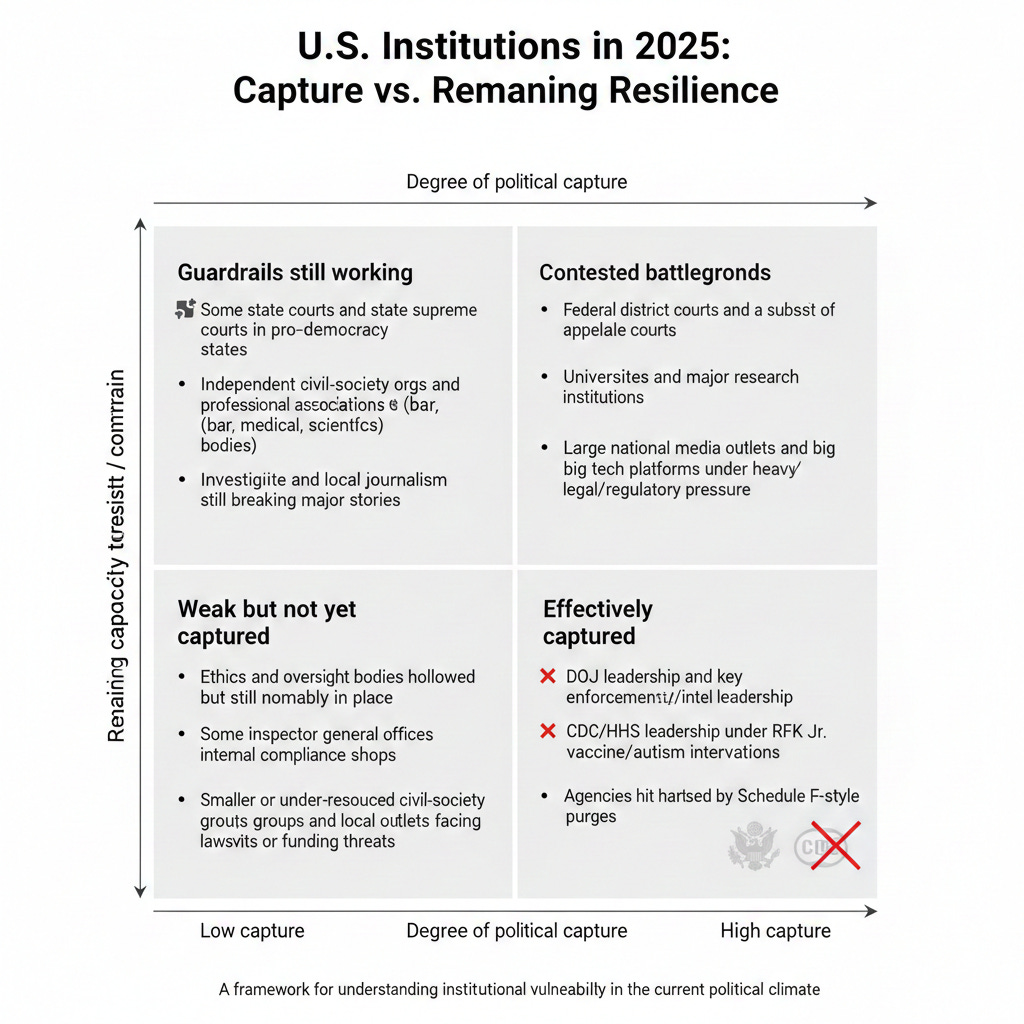
Experts conclude, the U.S. remains a competitive, but heavily compromised, democracy in which elections, courts, and a pluralistic civil society still exist, yet their capacity to meaningfully constrain presidential power has been sharply eroded.
Institutions are not “holding” so much as hanging on for dear life through scattered pockets of resistance. Lower courts, state governments, professional associations, investigative media, and some bureaucratic remnants can still slow, expose, and sometimes block authoritarian moves, but we cannot presume they will prevail by default.
And do Americans even care?
We asked this question earlier this year as well, Are Americans Ready to Give Up on Madisonian Democracy?
There is still a broad, abstract attachment to “democracy” and “checks and balances,” but support for restoring concrete institutions is shallow and heavily cross‑cut by openness to rule‑breaking strongmen, especially among Republicans and some younger cohorts. Polling suggests a sizable minority—and in some frames, close to half the country—is at least ambivalent about authoritarian arrangements, which is why institutional‑defense messages struggled in 2024.
This is not a pro‑institution climate: voters see institutions as failing or captured, so a message of “trust / restore the institutions” sounds, to many, like defending a discredited status quo rather than reform.
Congress, the presidency, and national media sit in or near the basement.
An Ipsos democracy poll and subsequent analyses highlight that younger Americans are more likely than older ones to rate an authoritarian strong‑leader system, a theocracy, plutocracy, or military rule as at least “fairly good,” even while most still say they prefer democracy overall.
For many voters—especially the disaffected and young—the institutions that are supposed to be defended are associated with inequality, gridlock, and hypocrisy, not with protection of their concrete interests. In that environment, calls to defend “norms” sound like elite self‑protection.
Polling in 2025 shows most young people value democratic principles but have low confidence that democracy works for them.
If we want to preserve the Republic, and avoid a slide into full-on autocracy, we have to turn this around. A framing for the future must pair democratic defense with concrete reforms and material benefits.
A message that might resonate better than “No Kings”
The ‘No Kings’ protests capture a real fear about creeping authoritarianism, but if we want to win more people over, we need a message that doesn’t just reject a monarch—it explains, in everyday terms, why democracy is better for their lives and what it looks like when it’s gone.
A future‑oriented, empirically grounded message about institutions for younger and disillusioned voters has to start from their lived reality: most say they like democracy in principle but do not believe it is working for them in practice. The frame, therefore, is less “save the institutions” and more “rewrite the rules so they actually protect you and don’t just shield the powerful.” Institutions become the operating system that decides whether you get pushed around by landlords, employers, debt collectors, corrupt cops, or hostile politicians—or whether you and your friends can push back and win concrete improvements in your lives.
The story of the future is that democracy is how people lock in victories that last: cheaper junk fees, fairer contracts, a livable climate, bodily autonomy, and online spaces that are not controlled solely by billionaires and extremists. That requires institutions—courts, watchdogs, agencies, local governments—that are rebuilt to be faster, more transparent, and more accountable, so they feel less like distant bureaucracies and more like tools people can actually wield. The message should emphasize that this is not nostalgia for a golden age of institutions that never really worked for everyone, but a commitment to building new guardrails that are anti‑corruption, pro‑youth power, and explicitly designed to keep the next strongman from wrecking their futures.
Finally, the frame needs to be hopeful without being naive: acknowledging that a chunk of the country is flirting with strongman politics because they are fed up with grift and hypocrisy, while arguing that giving one person the power to break the rules will always end with them breaking you. The alternative future on offer is not endless culture war or managed decline, but a repaired operating system where the same rules apply at the top and the bottom, where young people have built‑in leverage—on campuses, in workplaces, and in local budgets—and where public institutions earn back trust by delivering visible, trackable wins in everyday life.
From abstract to concrete
In short, a future‑facing message has to translate “democracy” from a moral abstraction into an everyday protection plan—and contrast that with the concrete harms of living without it.
A helpful way to frame it is: democracy is the set of rules and institutions that decide whether you can be evicted without cause, billed with junk fees, surveilled without limit, silenced at work or online, or targeted by the government with no recourse. When democracy works, those rules tilt toward ordinary people—giving you leverage against landlords, employers, monopolies, and politicians; when it fails or disappears, the same actors can act with impunity. So instead of saying “defend institutions,” the story becomes “keep and upgrade the systems that stop powerful people from pushing you around.”
The flip side is to show, just as concretely, what not having democracy looks like: leaders who can cancel elections or ignore results; courts and police used to settle scores; news and social media filtered to protect those in charge; and no lawful way to stop them. The argument is not that democracy is perfect, but that every real gain—safer workplaces, cleaner air, civil rights, reproductive freedom, protections for LGBTQ people, fairer economic rules—came from people organizing and then locking in changes through democratic structures. Take those structures away or hollow them out, and you don’t just lose an abstract ideal; you lose your only peaceful way to defend your rights, your livelihood, and your future.
At its core, protecting democracy is a non-partisan shared value because it means defending the system of checks and balances that ensures no single person or party can act above the law, abuse power, or strip rights without recourse. This fundamental guarantee—that the rules apply equally to everyone—is essential to both conservative principles of limited government and liberal principles of equal justice.
Democracy, rather than some distant abstraction, is the name we give to the everyday protections that stop the powerful from pushing us around—and we will either strengthen those protections together, or watch them disappear.