

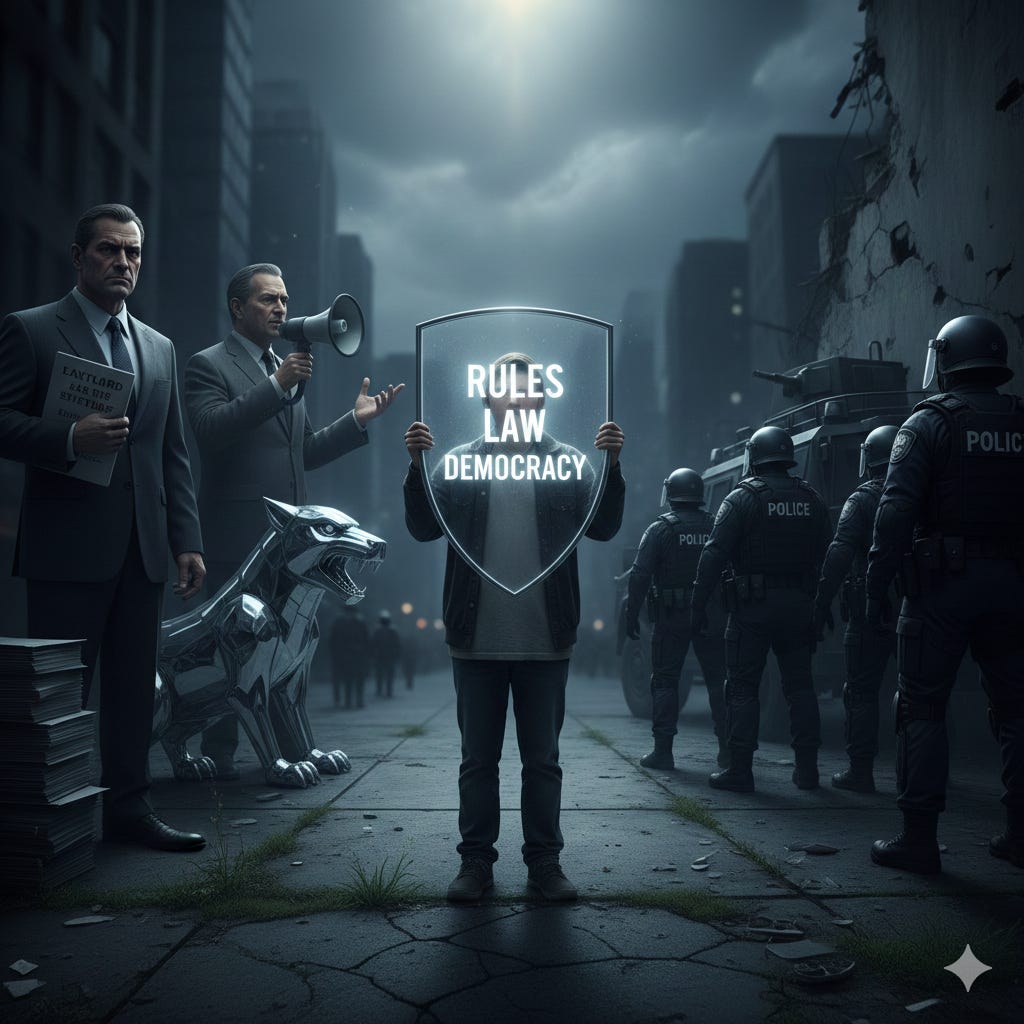
Editor’s note:
A version of this essay originally appeared as one section of a longer Substack post that covered several related themes. I’m republishing it here—lightly edited and expanded—as a standalone piece because this argument deserves focused attention: why “save democracy” messaging struggled in 2024, and how a more concrete, future-oriented case for democracy might resonate better with younger, more cynical, and disillusioned voters.
We asked this question last year: Are Americans Ready to Give Up on Madisonian Democracy?
The uncomfortable answer is: many are at least open to it.
There is still broad, abstract attachment to “democracy” and “checks and balances.” But support collapses when those ideas are translated into actual institutions. Polling consistently shows that a sizable minority—and in some framings, close to half the country—is ambivalent about authoritarian arrangements, especially when those arrangements promise decisiveness, punishment of elites, or rule-breaking in the name of results.
That is why institutional-defense messages struggled in 2024.
This is not a pro-institution climate. Congress, the presidency, and national media sit at or near historic lows in public trust. For many voters, institutions are not experienced as safeguards but as captured systems—gridlocked, hypocritical, and tilted toward the powerful. In that environment, “defend the institutions” does not sound like reform. It sounds like protecting a discredited status quo.
Younger voters aren’t anti-democracy—but they are anti-bullshit
Ipsos democracy polling and related analyses show something that unsettles older political narratives: younger Americans are more likely than older ones to rate authoritarian strong-leader systems, military rule, plutocracy, or even theocracy as at least “fairly good,” even while most still say they prefer democracy overall.
That contradiction matters.
Polling in 2025 shows that most young people value democratic principles, but have low confidence that democracy actually works for them. The institutions they are being asked to defend are associated, in their lived experience, with student debt, unaffordable housing, junk fees, climate paralysis, workplace precarity, and unaccountable power—not with protection or opportunity.
In that context, appeals to “norms” and “guardrails” often land as elite self-protection. Not because young voters are nihilists, but because they don’t see how those norms protected them.
If we want to preserve the Republic—and avoid a slide into full-on autocracy—we have to change the frame.
Why “No Kings” isn’t enough
The “No Kings” message captures a real and justified fear about creeping authoritarianism. But rejection alone is not a strategy. For voters who already feel shut out, it answers the wrong question.
The question many younger and disillusioned voters are asking is not, “Do I want a king?”
It’s, “What system actually stops people from screwing me over?”
A message that works for this audience has to explain—plainly and concretely—why democracy is better for their lives, not just better in theory. And it has to show what disappears when it’s gone.
Reframing democracy as an operating system, not a museum piece
A future-oriented message has to start from lived reality: people like democracy in principle, but don’t believe it’s delivering in practice. So the frame can’t be “save the institutions.” It has to be:
Rewrite the rules so they actually protect you—and don’t just shield the powerful.
Democracy isn’t a vibe or a moral abstraction. It’s the operating system that decides whether you get pushed around by landlords, employers, debt collectors, corrupt cops, monopolies, or hostile politicians—or whether you and people like you have leverage.
In this framing, institutions aren’t sacred relics. They are tools.
Courts, watchdogs, agencies, and local governments are how people lock in wins that last: cheaper junk fees, safer workplaces, fairer contracts, bodily autonomy, a livable climate, and online spaces that aren’t entirely controlled by billionaires and extremists.
That requires rebuilding institutions to be more transparent and more accountable—so they feel less like distant bureaucracies and more like things people can actually use. This is not nostalgia for a golden age that never worked for everyone. It’s a commitment to new guardrails that are explicitly anti-corruption, pro-youth power, and designed to stop the next strongman from wrecking people’s futures.
Hopeful without being naive
This frame also has to be honest.
Some voters are flirting with strongman politics because they are fed up with grift, stagnation, and hypocrisy. That frustration is real. But the hard truth is that giving one person the power to break the rules always ends with them breaking you.
The alternative future on offer isn’t endless culture war or managed decline. It’s a repaired operating system where the same rules apply at the top and the bottom—where young people have built-in leverage on campuses, in workplaces, and in local budgets, and where public institutions earn trust by delivering visible, trackable wins in everyday life.
From abstraction to protection
The simplest way to translate democracy for a cynical audience is this:
Democracy is the set of rules that decide whether you can be evicted without cause, buried in junk fees, surveilled without limit, silenced at work or online, or targeted by the government with no recourse.
When democracy works, those rules tilt toward ordinary people.
When it fails—or is hollowed out—they tilt toward whoever already has power.
The flip side must be just as concrete. Life without democracy looks like leaders who can ignore elections, courts used to settle scores, police and regulators deployed selectively, media filtered to protect those in charge, and no lawful way to stop it.
Every real gain people care about—civil rights and voting protections, Social Security and Medicare, minimum wage and overtime laws, women’s suffrage, cleaner government reforms, and safer workplaces and products—came from organizing and then locking those gains in through democratic structures. Remove those structures, and you don’t just lose an ideal. You lose your only peaceful way to defend your rights, your livelihood, and your future.
At its core, protecting democracy is not a partisan project. It’s about preserving the system of checks and balances that ensures no one can act above the law—an idea that should resonate with both conservative commitments to limited government and liberal commitments to equal justice.
Democracy isn’t an abstraction. It’s the everyday protection that stops the powerful from pushing us around.
We can strengthen those protections together—or watch them disappear.
It’s everything the Outrage Overload podcast is not. It’s not edited. It’s not scripted. It’s lightly researched. It’s David and Lisa talking about this week in outrage, what was in the news, in the memes, and maybe finding some backstory with a humorous (at least to us) twist.
Lisa is Mad that Hegseth is Being a Total Chud 🎖️🙄 - 1/11/2026

This week, Lisa and David talk about Dr. Oz new drinking guidelines; Pete Hegseth seeks to punish Sen. Mark Kelly (D-Ariz.) by reducing his retirement rank and pension; oil CEOs call Venezuela “uninvestable”; Trump administration to halt billions of dollars in federal funding for social services programs in five states: Minnesota, N…