


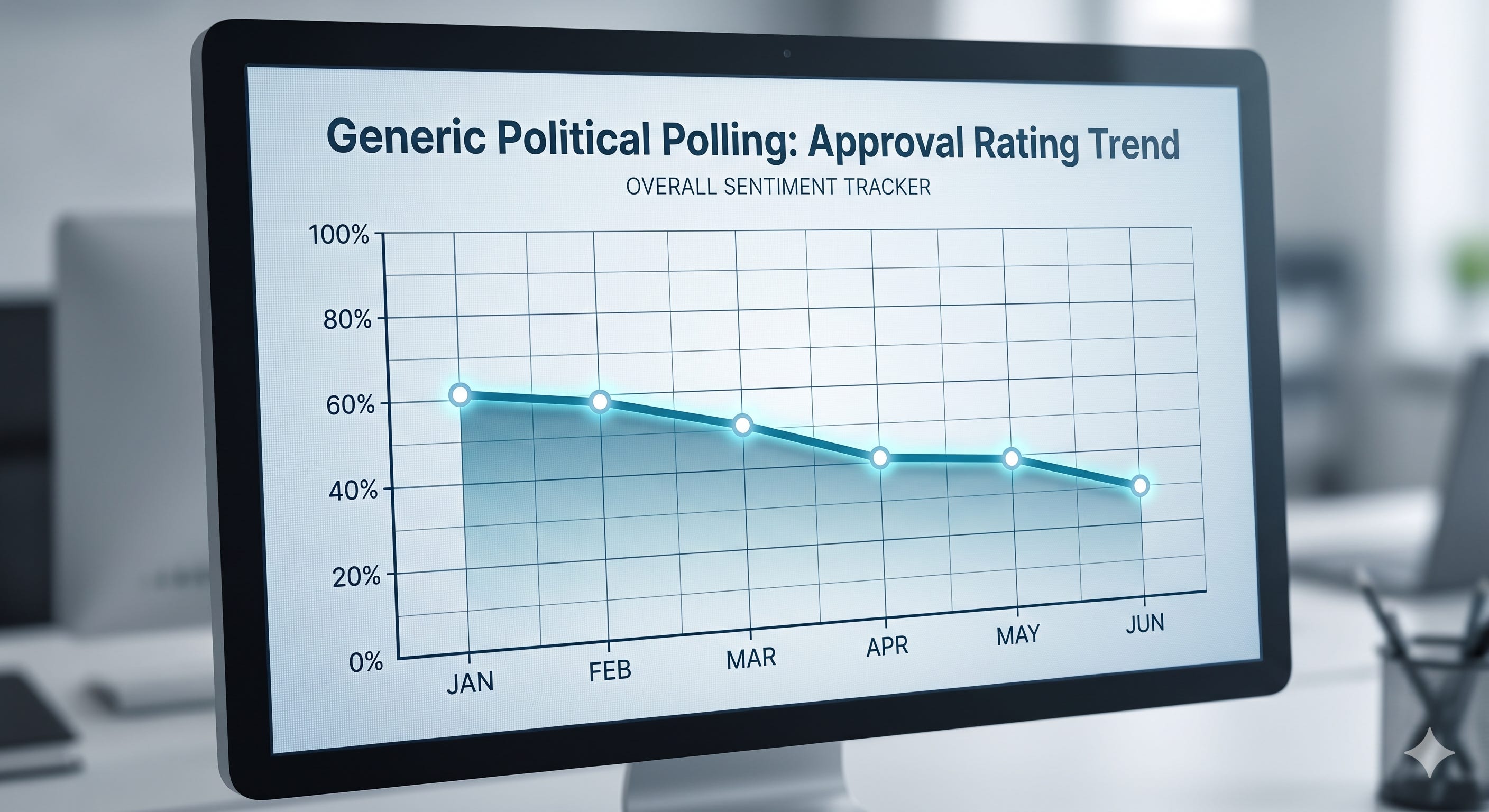
I myself am a bit exhausted by the stream of Democrats or left-leaning folks cheering about polls showing “historically low approval” for Trump and his policies.
A recent New York Times/Siena poll has Trump’s approval at 37%, and yes, that’s the lowest level since his return to office in January 2025. But, Trump has never been particularly popular. His average approval in his first term was 41% and he never did better than 50%.
Presidential approval ratings are historically characterized by cycles, starting with a high “honeymoon” period, dipping during midterms, and recovering significantly by the end of their tenure. That was true for Obama, who started at 69%, saw a low of 38%, and finished at 59%.
Trump, by contrast, never followed this pattern. Instead, he has seen a highly polarized, flat baseline that rarely fluctuates outside a tight margin. And 37% is within that margin. It’s not an anomaly or wild aberration.
At the start of his second term, his honeymoon period, Trump was at 47% which is about the same as his first time, 49%. For reference, Biden started his term at 59% and finished at 40%. So yes, 37%, is a big drop from where Trump started, but it’s about where he has always lived.
There’s a clear “yes and no” aspect to this “Trump is tanking” narrative. Yes, Trump has cratered with independents. His policies are generally unpopular, even on the issues where he was historically strong, like crime and immigration. But his base really hasn’t broken. While this environment spells trouble for the upcoming midterm elections—for all the typical historical reasons facing an incumbent party—it is not the absolute political crash many on the left want to believe. Crucially, as unpopular as Trump is, Democrats are even more unpopular, meaning voters fleeing Trump will not automatically pull the lever for the opposition.
A new Fox News poll shows President Trump’s approval rating among Republicans at 80%. While that represents a notable drop from his previous 90% to 95% highs, it remains remarkably resilient. This 80% floor carries immense political consequences. On one hand, it means Trump still commands massive power and acts as the gatekeeper of his party. It also creates an environment where partisans can convert accusations about constitutional abuse, rule-of-law violations, or corruption into a partisan loyalty test rather than a governing problem. When most co-partisans still stick with him, those criticisms are easier to reframe as attacks from hostile elites, so the facts do not automatically build the kind of cross-party coalition needed for reform.
That kind of Republican approval level is high enough to tell politicians, donors, and media figures that there is still a durable base willing to defend Trump even under heavy criticism. That reduces the incentive for Republican officeholders to break with him, because the political cost of alienating the base can be higher than the cost of ignoring institutional concerns. In practice, that means even serious allegations can be dismissed as “witch hunts” or treated as factional warfare instead of a call for institutional repair.
Repairing constitutional or rule-of-law breakdowns historically requires a broad coalition — and that coalition almost always needs buy-in from members of the president's own party. In practice, though, that buy-in is hard to come by when Republican elites see primary challenges as an existential threat.
The result is a cycle that’s hard to break. When someone criticizes the president, his supporters rally around him even more strongly. That loyalty makes it nearly impossible for Republican politicians to speak out — because if they do, they risk losing their own voters. So bad behavior goes unchecked, and the cycle continues.
By comparison, during Watergate, Nixon’s approval among Republicans had fallen to about 50%, with roughly 38% of Republicans disapproving in the last poll before his resignation. In Nixon’s case, the Republican base was divided, but not uniformly hostile, which helped explain why congressional Republicans had some room to maneuver, though not enough to save him.
It also matters for the midterms. In gerrymandered districts, that kind of intense in-party loyalty can help Republicans hold seats, especially where the general election is mostly decided in a low-turnout primary or in a heavily red district. It means Trump still functions as a strong cohesive force inside the party, which helps incumbents and Trump-aligned candidates avoid serious intraparty revolt.
With some of the redistricting, where in order to get more red districts, the margins have been made thinner, Republican approval starts to matter a lot. If a district is drawn to R+5, R+7, or R+8, then a small share of defections, lower turnout, or protest abstention can erase the map’s advantage. The tighter the district, the more the incumbent depends on keeping nearly all Republican voters aligned and motivated.
With Republican approval around 80% it probably doesn’t matter. But if it slips toward the 60s or lower, the incumbent can lose the cushion that protects against national swings, bad candidates, or a strong Democratic year. That is especially true in midterms, where turnout is lower and base enthusiasm matters more than persuasion.
Ultimately, yes, Trump’s overall approval has fallen and his agenda faces headwinds. But unless his approval among Republicans drops significantly, this is a story of political polarization, not a structural collapse. Trump still functions as the definitive symbol of his party, he retains massive gatekeeping power, and his slide in the polls is far from the catastrophe his critics portray—and it certainly doesn’t mean the country has suddenly fallen in love with the Democrats.