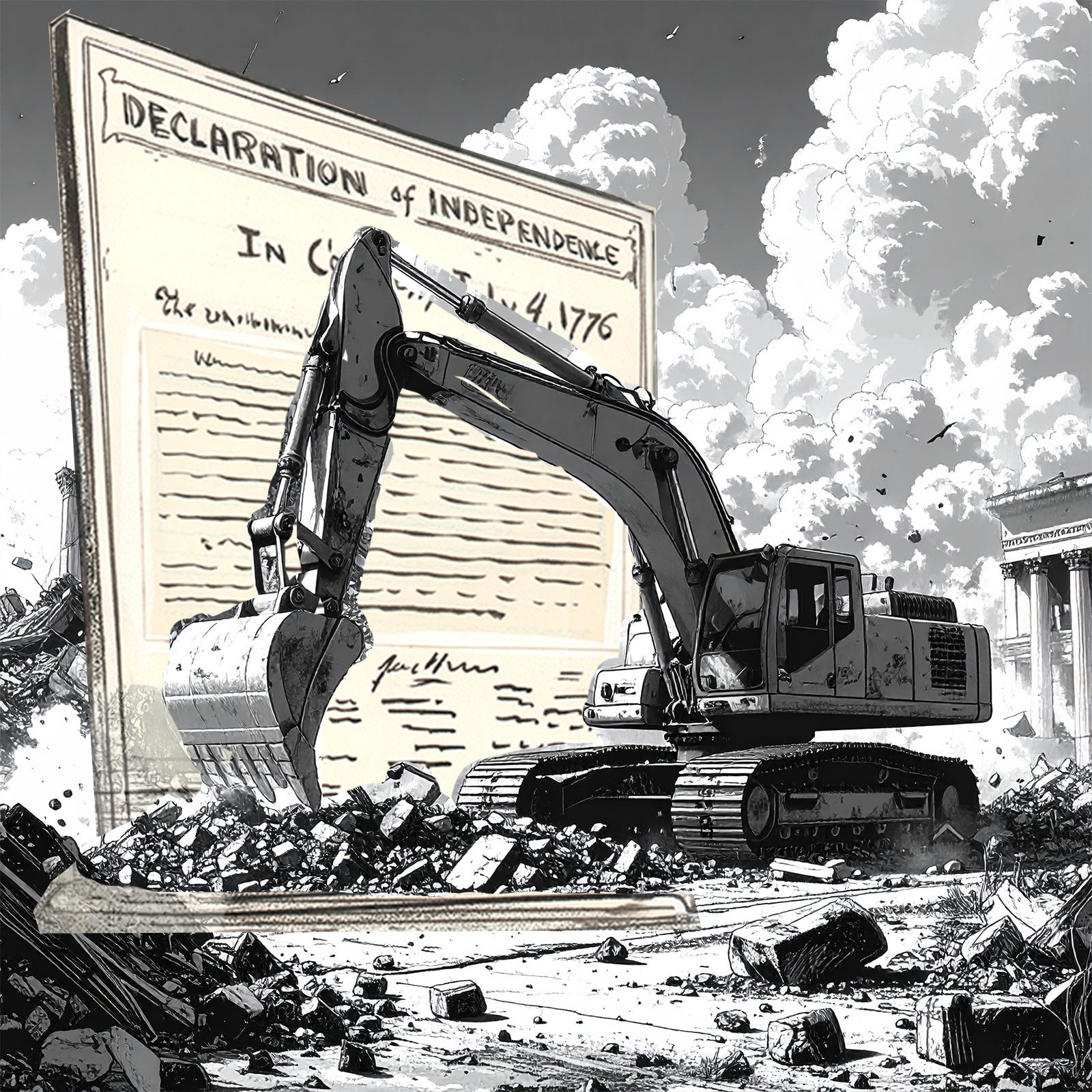
This week, Lisa and David talk about Grace Cathedral multimedia experience; Waymo driverless cabs; Freemasons convention; Marines fire live artillery over Interstate 5 on No Kings day; controversial demolition of the White House East Wing and potentially bogus donor list, amid complete lack of public transparency; despite budget cut boasts, national debt and deficit skyrocket, fueled by unaccounted spending and grift; withdrawal of Paul Ingrassia’s nomination suggests Republican senators do have a line where they will stand up to Trump (but apparently not Tulsi Gabbard, RFK, Jr, Hegseth, Patel, or other lesser known figures like Elbridge Colby and Darren Beattie); David’s analysis of Isaac Saul’s pivot to recognizing the severity of Trump’s authoritarian actions; gaslighting of the week, coming from the Oval Office; kids speak up about Halloween candy; and more.
Summary of David’s Analysis of Isaac Saul’s Piece, “Yes, things are pretty bad right now”
David notes that the article represents a significant shift for Isaac Saul, who had previously been critical of what he termed “Trump derangement syndrome,” warning against “seeing ghosts” or overreacting to events.
Change in Tone: Saul acknowledges that his previous concerns about hyperbolic reactions are now overshadowed by real events. He states that things he previously would have dismissed as overblown are “actually happening,” specifically citing a list of authoritarian tendencies and actions by Trump.
The “Five Things” Critique: David brings up his past critique of Saul’s “five things” metric—a list of extreme actions (like arresting political adversaries) that Saul suggested would be a true cause for worry. David’s past argument was that by the time those things happen, “it’s way too late.” Saul’s new piece suggests he is now recognizing the severity of the situation before reaching that point.
Reaction and Analysis of Tangle’s Readership
The analysis heavily focuses on the reaction to the piece in the comment section, which reveals a changing dynamic within Tangle’s audience.
Shifting Audience: Tangle, the newsletter put out by Saul’s organization, had historically prided itself on having a 50-50 Republican/Democrat readership and a reputation for being nonpartisan and “rational across the board.” However, David notes that the audience has become “less conservative” and “more left-leaning.”
Conservative Backlash: A number of commenters reportedly threatened to cancel their subscriptions because they viewed the piece as being partisan or abandoning the newsletter’s neutral stance.
The Overton Window Argument: David argues that Tangle hasn’t changed its position; rather, “the right has changed.” He posits that what conservatives now find acceptable as a nonpartisan news source has become so extreme that outlets like Tangle (and even NPR) are now considered too left-leaning. Their “Overton window”—the range of ideas tolerated in public discourse—has moved further to the right, forcing any genuinely non-partisan organization to be viewed as “radical left” by those seeking more partisan, extreme content.
Rationalization of Hypocrisy: Saul reportedly uses hypothetical scenarios (e.g., what if a future Democratic president did X, Y, or Z) to test readers’ principles. David observes that conservative readers are quick to offer rationalizations for why the hypothetical action would be different or acceptable if done by a Republican, proving they “don’t give a f*** about the hypocrisy” and are simply partisan.
Alternative View: Reinterpreting “Authoritarianism” as “Disruption”
Isaac Saul’s analysis acknowledges a powerful alternative framework through which Trump’s actions, often labeled as “authoritarian drift,” are perceived by his supporters. This framework reinterprets the intent and effect of these actions, viewing them as a necessary and overdue correction of a failed status quo, rather than a threat to democracy.
The core of this alternative argument is a rejection of the “authoritarian” label. Supporters view Trump’s approach not as a power grab, but as a commitment to disruption and reform after years of institutional failure.
Necessary Course Correction: The drift is seen as a necessary move away from a previous liberal or progressive institutional drift, thereby re-centering the nation rather than pulling it toward autocracy.
Bulldozing Bureaucracy: Actions that alarm critics—such as weakening federal agencies or dismissing established procedures—are framed as an “overdue disruption” that cuts through ineffective bureaucracy, fulfilling a mandate to improve efficiency and responsiveness.
The argument maintains that the system of checks and balances remains operational, and that future historians may validate the necessity of the current turbulence.
Courts are Still Checking: The existence of a functioning judiciary is cited as evidence that the system is not broken. The assertion is that the courts are “still functioning as they always have”, but are now simply ruling in ways “Democrats loathe”—implying the opposition’s distress is due to a loss of political power, not a loss of democratic process.
The Reckoning: The final point suggests a long-term historical perspective might ultimately vindicate Trump’s second term. The norm-breaking is hypothesized to be a necessary, albeit messy, process—a “reckoning we actually needed”—that will eventually lead to a more positive and stable trajectory for the nation.
Links:
Yergz Radio (yergzradio.com)
Dare Talk Radio (daretalkradio.com)
This Week in Outrage Substack (outrageoverload.net/twio)
What went wrong when Marines fired over Interstate 5? (Cal Matters)
What donors to Trump’s White House ballroom stand to gain from the federal government (CBS News)
Trump nominee withdraws after offensive texts allegedly emerge (BBC)